Dolomitgrau
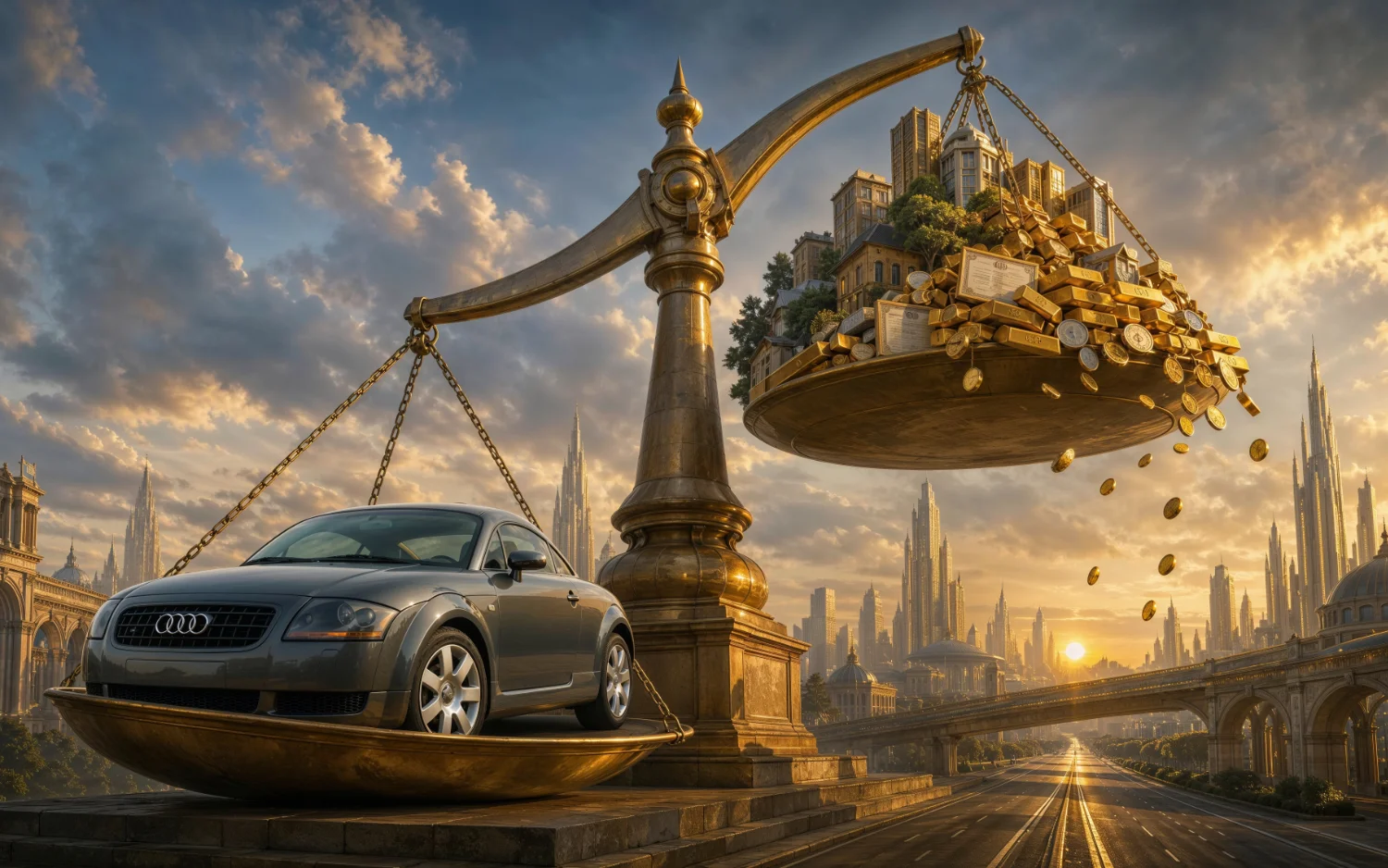
The Car That Cost Me a Million Euros
I have made expensive mistakes. With my first few salaries, I bought an Adobe Creative Suite Professional license for 1.500 € and a Maya Complete license for 5.500 €, because I was certain I would become a 3D artist. I did not. Then I upgraded Creative Suite twice for another 1.800 €, Maya once for 2.500 €, and bought Maya training books for maybe 300 €. Eleven thousand euros for a career that never happened.
That still wasn’t my most expensive mistake. My most expensive mistake was a car.
The UFO on the Other Side of the Road
Somewhere in 2000 or 2001, I was sitting in the back of the family car, driving into the city to go shopping, when something passed us on the opposite lane that I had never seen before. Round lines, steel grey, low. It looked like a prop from a science fiction film. There were no phone cameras in 2001, so all I had was a memory and a shape. My father had seen it too, and I pestered him for weeks until he went through the group’s model catalog at work — he was at Volkswagen — and found it: an Audi TT.
I had just finished my studies, had just started my first job, and was still living with my parents. For the next few months, I was obsessed. I opened the Audi configurator so often that I could have rebuilt my dream car from memory:
- Audi TT Coupé 1.8 T, 132 kW (180 PS)
- Dolomit grey, pearl effect
- Genuine leather “Soul”
- Electronics package
- Winter tires 205/55
- Cup holder
- CD changer (3 CDs)
- Bose sound system
- “Concert” radio
- Navigation system
List price: 35.625 €. Around 57.000 € in today’s money. Unthinkable on a beginner’s salary — so I kept pestering my parents until they offered me a 0% loan I could pay back at my own pace. Thanks to my father’s employee discount, the car came to 29.282,65 €. A few months later, I drove to Autostadt Wolfsburg and picked up a brand-new, shining Audi TT.
I felt like the king of the world. Empty three-lane autobahn at seven in the morning, 235 km/h on the way to my first job. Every material felt and looked expensive, not like the cheap plastic shells that are normal today. The leather smelled new for years. The sound system was magnificent. And when I pulled into the company parking lot for the first time, colleagues came out of the office just to look at it, with exactly the envious faces a 23-year-old hopes for.
I kept it for 14 years and sold it for 5.500 € to a moderately famous film director from Berlin who wanted it for his collection.
What Nobody Tells You About a Nice Car
Nobody mentioned that an expensive car is also expensive to keep. Every one to two years, an inspection for 500 €. A clutch for 5.000 €. Two or three windshields, killed by stone chips. A broken suspension. Countless calls to Audi service because the battery had died again in a week I hadn’t driven. And hours upon hours of my life spent sitting in a service waiting area, dropping the car off, picking it up.
In 14 years, I never had an accident — except for the truck driver who rolled past the line at a traffic light, couldn’t see it, and put his vehicle into reverse. He destroyed my radiator before he noticed me.
Germany Does Not Teach Money
Before I get to what the car really cost, a detour.
Germany has a catastrophic economics education. Depending on the study, 72–80% of Germans put money aside every month, but only 20–30% own stocks or ETFs — and before ETFs became popular, that number was far lower. My grand aunt kept her money in a savings account for 93 years.
I learned nothing in school about investing, markets, interest, or inflation. We had one or two years of economics, and they were about the social market economy and Keynesian ideas, though nobody told me that’s what they were. So I spent 35 years not understanding money at all. My parents bought federal treasury bonds for us children. My father had a single framed Volkswagen share hanging on the wall. When I started working, I parked around 350 € a month in a money market account at nearly 0% interest, and 40 € a month in a DWS fund I didn’t look at for years — long enough to find out much later that a managed fund happily keeps around half of the capital gains for its “services.”
What I did get was folk wisdom: keep two salaries in your current account, and keep 10.000 € ready in case the washing machine dies.
None of this is an accident. Germany has lived through two totalitarian socialist regimes, and even in the West the market has become a little less free every year since Ludwig Erhard. Government spending now stands at 51% of GDP — a level Helmut Kohl himself once called socialism. The tax wedge on a single average earner is 49,3%, the second highest in the OECD, compared with an average of 35%. And the result shows up in the numbers that matter: median wealth in Germany is around 46.000 €, ranking 30th in the world, below Greece, Portugal, and Spain.
Germany is rich, but the Germans are poor.
That gap feeds the resentment. Wealth here hides behind tall hedges and anonymous doorbells, while in other countries it is worn openly as gold. Envy is the national sport, and socialist parties are its trophy.
Interest Is Not a Sin
I once spent two hours trying to explain inflation to my brother-in-law and failed. He could not accept that 150 € in 2000 is not 150 € in 2020, and that roughly 46% of the value had quietly evaporated.
Interest is understood even worse. Since Luther, Germans carry the idea that charging interest is somehow unclean, the trade of the “greedy moneylender.” But interest is only time made visible. Everyone prefers a thing now to the same thing later. If you want someone to postpone their consumption, you must pay them for it, and that payment is interest. It works in both directions: if you want money now, you must find someone willing to wait and compensate them.
Then it multiplies. One euro invested at a child’s birth at a net 8% is nearly 150 € by retirement. A thousand euros becomes almost 150.000 €. Time and interest are the strongest levers a normal person has. If you understand them, they work for you. If you don’t, they work against you.
What the Car Actually Cost
I only learned all of this in my late thirties, when I joined a team at work that talked about ETFs and Bitcoin. I read Gerd Kommer’s Souverän investieren mit Indexfonds und ETFs, opened a brokerage account, passed my bank’s trading tests, and moved everything I had saved by my mid-thirties — around 65.000 € — into stocks and ETFs. Then I found the Austrian School, read more than sixty books on economics, became an Anarcho-Capitalist, and finally understood what money is.
That is when the bill for the TT arrived.
Purchase price, maintenance, and fuel over 14 years came to nearly 65.000 €. With that money, plus my savings, plus the fund contributions in equities at 10%—below the real return over the last 15 years—it would have been close to 350.000 € after those 14 years, which is more than halfway to a million (due to interest). Increasing the rate by 5,9% per year, along with my salary, for the next nine years would have put me past one million euros by 2026.
I didn’t, because I had a nice car. So instead I now set aside a far larger share of my salary than I ever would have needed to, trying to buy back time I already spent. The lever I gave away was not the money. It was my twenties and thirties.
It would have been larger still if my parents had been financially literate. When my nephew was born eleven years ago, there was 250 € on the table: 150 € from his parents, 75 € from his grandparents, 25 € from me. My condition was that it had to be invested. I tried to convince my sister to open a children’s account, and failed. If that 250 € had gone into an ETF, and she had continued with 250 € a month, raising it by just 3% a year, he would have been a millionaire at 33. Instead, the money went into a savings account, where 32.400 € of contributions will shrink to about 27.140 € of purchasing power over 18 years.
I understand the objection. Investing looks like gambling, and you never have money left over. But almost any asset would have beaten holding fiat money. Cumulative net returns, 2015 to 2025:
| Asset | 10-year return |
|---|---|
| USD ($) | -26% |
| EUR (€) | -22% |
| MSCI Emerging Markets ETF | 107% |
| Real estate (Germany) | 112% |
| MSCI World ETF | 204% |
| Silver | 206% |
| Gold | 249% |
| Apple (AAPL) | 925% |
| Tesla (TSLA) | 2.882% |
| Bitcoin | 49.900% |
High taxes and permanent inflation have trained an entire country to live with a high time preference. The new TV, the new car, the new iPhone, the rented scooter for a distance you could walk, the food delivered instead of cooked, two vacations a year for the Instagram grid, the cocktails on the rooftop, the endless small purchases of things nobody needs. It keeps people poor, and poor people resentful.
As long as central banks can expand the money supply at will, they are taking your lifetime, and scarce assets are the only place your work can survive. I wish someone had told me I could have been independent in my early forties. I would have skipped the car — and most of the rest.